

What if a single night’s sleep could reveal early signs of health problems, without the need for expert analysis or lengthy questionnaires?
Researchers from the University of Oxford’s Podium Institute for Sports Medicine and Technology and the Institute of Biomedical Engineering, Dr Nivedita Bijlani, Zekeriye Nur and Professor Mauricio Villarroel, have developed an AI-powered tool that can objectively measure sleep disruption from overnight physiological recordings. Published in Biomedical Signal Processing and Control in the paper “Multimodal sleep stage classification and label-free abnormality scoring in mid-to-older adults”, the study shows that AI can not only identify sleep stages accurately in older adults but also generate an objective score of sleep abnormality, potentially creating a scalable new way to monitor sleep health and detect sleep disruption over time.
The Challenge of Measuring Sleep Health
Sleep architecture – the sequence of light, deep and REM sleep across a night – is conventionally assessed either by a specialist manually scoring every 30-second segments of an overnight recording, or by asking an individual to rate how well they slept. The first approach is labour-intensive, time-consuming and difficult to scale as it requires an overnight stay in a sleep laboratory followed by hours of expert analysis. The second is subjective and prone to recall bias. Together, these limitations make it difficult to monitor how sleep changes in everyday life, across weeks, seasons and years.
Why Sleep Disruption Matters
REM sleep behaviour disorder (RBD) is a condition in which the muscle atonia that normally accompanies dreaming fails, and the sleeper physically enacts their dreams. It is among the strongest known early markers of neurodegeneration: most of those diagnosed go on to develop Parkinson’s disease or a related condition, often decades later. Disrupted sleep is in this sense both a consequence of neurological change and one of its earliest signals.
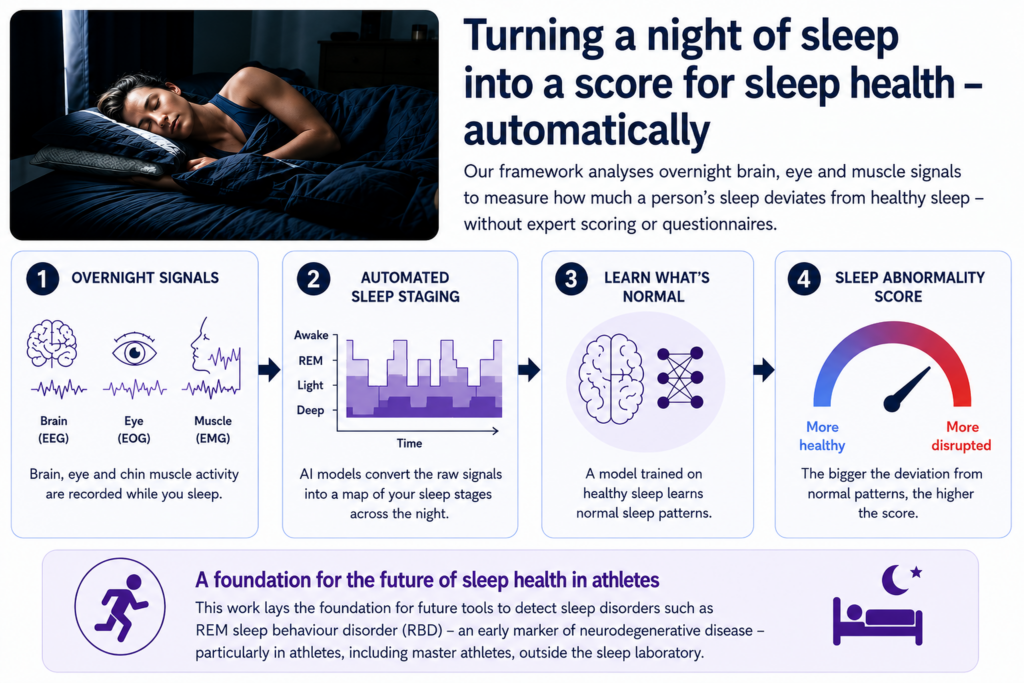
The researchers developed a new label-free method for objectively measuring sleep disruption from overnight physiological signals. The framework first uses an AI model to analyse brain, eye and chin muscle activity and reconstruct a hypnogram, a map of how sleep progresses throughout the night. A second model then uses the individual’s sleep pattern to produce a single score describing how much that night’s sleep departs from a healthy profile, without requiring expert annotation. Evaluated on more than 500 overnight sleep recordings from adults aged 40 years and older, the method produced scores that closely reflected established measures of sleep quality, increasing with sleep fragmentation, poorer sleep efficiency and more frequent awakenings. Because the score remains largely independent of age, it offers a promising way to monitor how sleep changes within the same person over time, whether due to ageing, training or disease.
Nivedita Bijlani, Post Doctoral Researcher at the Podium Institute commented “Current methods either require an expert to score an entire night’s recording or rely on what someone remembers about their sleep. We set out to develop a measure that comes directly from the structure of the night’s sleep itself, making it possible to assess sleep objectively and consistently over time”.
Implications for Athlete Health and Long-Term Monitoring
The ability to monitor sleep objectively over long periods is particularly important in athletes. Between a quarter and a third of current and former athletes report a diagnosed sleep disorder. REM sleep behaviour disorder (RBD), in which people physically act out their dreams during REM sleep, is of particular concern because it is one of the strongest known early markers of neurodegenerative disease. It is more common in contact sport athletes than in the general population. Detecting RBD currently relies on specialist sleep laboratories, limiting opportunities for repeated assessment. By providing an objective, annotation-free measure of sleep architecture, this work lays an important foundation for future technologies that could help identify sleep disorders in athletes, particularly master athletes, and support long-term monitoring outside the laboratory. Such monitoring may also help identify early signs of inadequate recovery, accumulated fatigue, overtraining and emerging health concerns before they become clinically apparent, supporting more informed and personalised approaches to athlete health, performance and long-term care.
“Sleep naturally varies from night to night, across weeks, seasons and years. A single night in a sleep laboratory offers only a snapshot of how someone sleeps, telling us remarkably little about their sleep in everyday life. To understand how sleep changes with ageing, training or disease, we need new methods that are objective, repeatable and can scale to monitor people at home. This work is an important step towards making long-term sleep monitoring practical outside specialist clinical settings” – Prof. Mauricio Villarroel, Professor of Biomedical Engineering and senior author.
ABOUT THE PODIUM INSTITUTE
The Podium Institute for Sports Medicine and Technology at the University of Oxford, is the world’s first independent academic institute focused on the safety and lifelong health of youth and grassroots, as well as professional, athletes. Its purpose is to inspire and forge evidence-based changes in sport and physical education, and to develop innovative and scalable technologies to monitor, analyse and ultimately prevent sport injury across the 22 million adults and 3 million children who participate in sport annually across the UK, as well as the hundreds of millions who partake in amateur and professional sport internationally.
For queries, please contact podiuminstitute@admin.ox.ac.uk