
A new study from researchers at the University of Oxford’s Podium Institute for Sports Medicine and Technology and the Department of Engineering Science has found that an easy-to-use smartphone-based motion capture technology shows promise for monitoring athletes outside the laboratory, but it is not yet accurate enough to reliably assess complex gymnastics movements.
Published in the Journal of Biomechanics, the study, “Evaluation of a smartphone-based markerless motion capture system for assessing the kinematics of gymnastics,“ was led by Lucy Buchanan, alongside Professors Amy Zavatsky and Liang He.
Why does monitoring gymnastics movement matter?
Understanding how gymnasts move in the gym is critical for investigating injury mechanisms, identifying potential risk factors, and evaluating injury prevention strategies. Traditionally, biomechanical analysis has relied on laboratory-based systems such as Vicon motion capture, which require specialist equipment, dedicated facilities and reflective markers attached to the body.
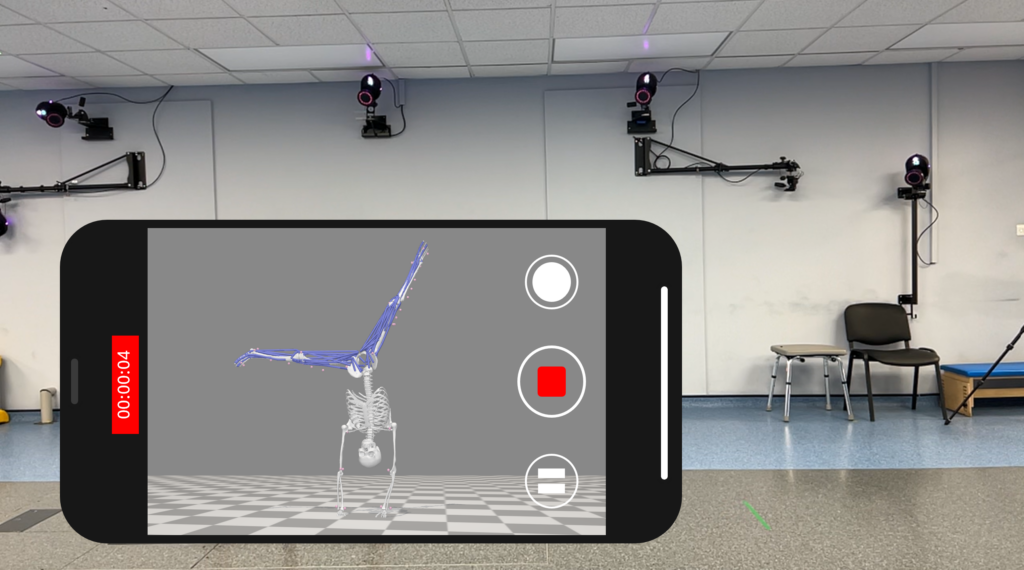
Markerless motion capture[1] systems offer a potentially transformative alternative. Using ordinary smartphone cameras, they could enable coaches, clinicians and researchers to analyse movement directly in training environments, making biomechanical assessment more accessible and scalable.
However, before these systems can be used with confidence for gymnastics, it is essential to understand how accurately they capture the complex movements performed by gymnasts.
Gymnastics places extraordinary demands on the body, with athletes repeatedly performing high-impact landings, weight-bearing skills and complex movements that can increase injury risk. Research in young gymnasts has found that 70% of those reporting an injury continued to train with modifications, highlighting the importance of being able to monitor athletes within their everyday training environment[2].
Testing smartphone-based motion capture in gymnastics
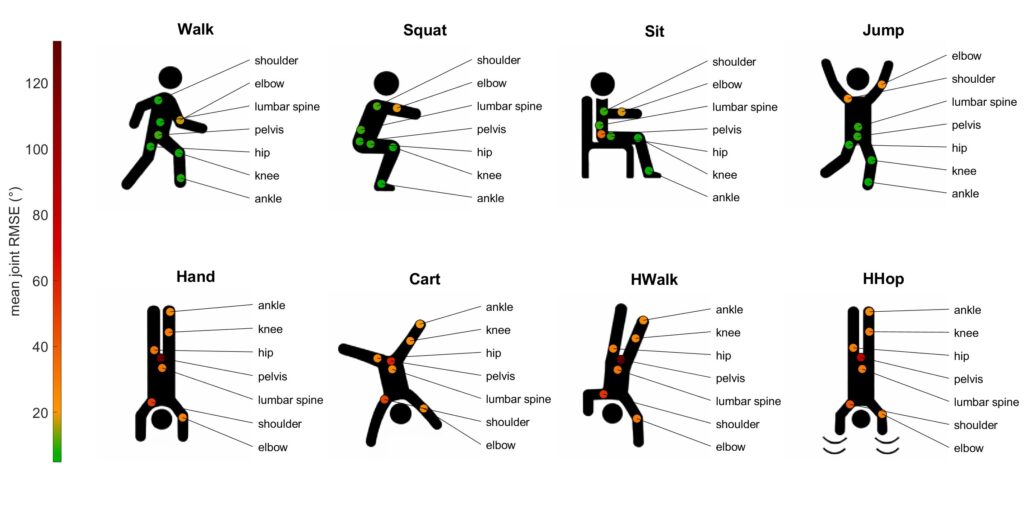
The team compared OpenCap[3], a smartphone-based markerless motion capture system, with Vicon, a gold-standard marker-based motion capture system. Ten participants were recorded simultaneously using both systems while performing a range of functional everyday tasks and gymnastics-specific movements, including walking, squatting, sit-to-stand, drop jumps, handstands, cartwheels, handstand walking and handstand hops. The researchers then assessed how closely the measurements from OpenCap matched those from Vicon across different movement types and body regions.
Thie findings showed that the gymnastics movements could not be tracked to the same accuracy as the everyday functional tasks. Activity-specific modelling approaches improved this, but the accuracy was still not as good as that for non-gymnastics’ movements.
Additional development and validation will be needed before this system can be confidently used to monitor gymnastics performance in real-world training environments.
“Markerless technology has huge potential to help us understand how athletes move in real-world training environments, but it is essential that we continue to rigorously test and validate these models so that we know we can trust the data they produce. Gymnastics presents a particular challenge because of the complexity and variety of movements, and our findings suggest that, in its current form this markerless technology is not yet accurate enough for us to use confidently in this setting. As these technologies continue to develop, more representative training datasets could help unlock their potential for gymnastics and other complex sporting movements. In the meantime, we’ll continue to think of innovative ways to monitor gymnasts in their training environment to better inform injury prevention strategies.” Lucy Buchanan, first author and Podium Institute DPhil candidate.
Professor Amy Zavatsky, Professor of Engineering Science and senior author of the study, added: “In this work, we compared how well a markerless motion capture system in its off-the-shelf implementation and a marker-based motion capture system could each track body kinematics during a few ordinary daily activities and some basic gymnastics tasks. As well as identifying differences in the outputs from the two systems, the study highlighted technical challenges encountered by both systems, such as locating body segments like the pelvis when key anatomical landmarks are occluded. It also revealed that the representations of some anatomic joints in the kinematic models used need to be improved so that the extreme body postures assumed in gymnastics can be represented accurately. These are important areas for further development.”
Looking ahead
While smartphone-based motion capture is not yet ready to replace laboratory systems for analysing complex gymnastics skills, this research represents an important step towards making biomechanical assessment more accessible beyond specialist facilities. It highlights the challenges of applying markerless motion capture to movements that differ substantially from those typically represented in model training datasets. Further development, including training models on a greater variety of sporting movements, could improve their accuracy for gymnastics and other complex activities. This could help bring athlete monitoring directly into training environments, supporting future research, performance development and injury prevention in gymnastics and beyond.
[1] Markerless motion capture uses multiple smartphone or video cameras and artificial intelligence to measure an athlete’s movement without the need for wearable sensors or reflective markers.
[2] Williams, E., Lloyd, R., Moeskops, S., & Pedley, J. (2023). Injury Pathology in Young Gymnasts: A Retrospective Analysis. Children, 10(2), 303. https://doi.org/10.3390/children10020303
[3] Uhlrich SD, Falisse A, Kidziński Ł, Muccini J, Ko M, et al. (2023) OpenCap: Human movement dynamics from smartphone videos. PLOS Computational Biology 19(10): e1011462. https://doi.org/10.1371/journal.pcbi.1011462