PoseDreamer, a new AI-generated dataset, could improve the study of human movement, performance and recovery
September 7, 2026
From analysing athletic performance to helping patients recover from injury, understanding how the human body moves is central to fields ranging from sports science and healthcare to robotics and artificial intelligence. Yet one of the biggest obstacles facing researchers is surprisingly simple: obtaining enough high-quality data.
Researchers from the Podium Institute for Sports Medicine and Technology and the Visual Geometry Group (VGG), Department of Engineering Science, University of Oxford believe they have found a solution! Their new system, PoseDreamer, uses generative AI to create photorealistic images of people while simultaneously generating detailed three-dimensional information about their bodies. Presented in the paper PoseDreamer: Scalable and Photorealistic Human Data Generation Pipeline with Diffusion Models , the work could make it significantly easier to build the large datasets needed to train the next generation of movement-analysis technologies.
Commenting on the findings, Lorenza Prospero, Podium Institute DPhil student and first author of the paper, said: “PoseDreamer is a first step towards bridging the gap between the realism of real-world photographs and the precise 3D labeling of computer-rendered images. Across diverse models and domains, the two approaches have strengths and weaknesses which can complement and enhance one another.”
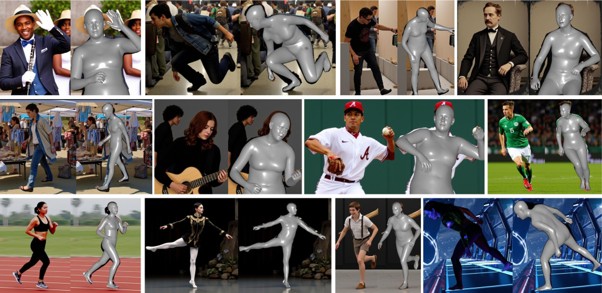
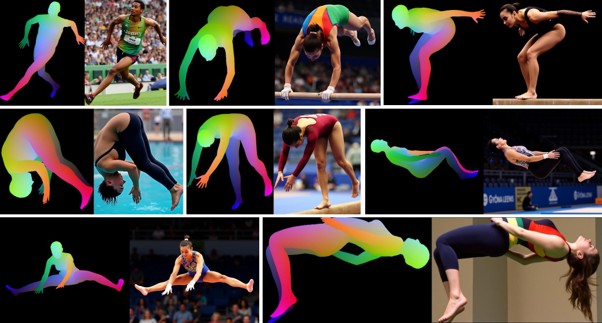
Examples from the PoseDreamer Dataset. High-quality synthetic human samples generated using the pipeline. The examples highlight photorealistic appearance, precise spatial control, and diverse, challenging scenarios that support robust model training.
Creating data at scale
Modern AI systems learn by example, but collecting large volumes of accurately labelled movement data is expensive and time-consuming. Researchers often rely on specialised motion-capture facilities that use cameras, sensors, and reflective markers to record movement in three dimensions. While highly accurate, these systems are costly to operate and can capture only a limited range of activities and environments.
The alternative is rendering engines, which generate images from 3D models and therefore come with perfect labels built in. The catch is that the results still look synthetic, and building enough varied characters and scenes is costly in itself.
PoseDreamer takes a different approach. Using diffusion models, the same family of AI technologies behind many image-generation tools, the system creates realistic images of people performing a wide variety of activities in diverse settings. At the same time, it generates precise 3D body annotations, providing the information needed to train computer vision models.
The result is a dataset containing 500,000 photorealistic human images, each paired with a detailed 3D body mesh[1] , achieving a 76% improvement in image quality over conventional synthetic datasets.
Professor Christian Rupprecht, senior author of the study, commented: “As diffusion models keep improving, using the images they generate to train other models is a natural next step. PoseDreamer shows they have passed the point of being merely realistic, they are now genuinely useful for downstream tasks.”
Why it matters
The significance of the work goes beyond the size of the dataset. The researchers demonstrated that the system can be adapted to specific domains simply by generating additional examples of particular activities. In one example, they improved performance for yoga-related movements by creating more yoga-focused training data.
This flexibility could be especially valuable in sports science, where certain movements are difficult to capture at scale. More diverse datasets may help researchers develop better tools for analysing technique, monitoring athletic performance, and identifying movement patterns associated with injury risk.
The potential applications extend beyond sport. In healthcare and rehabilitation, improved movement-analysis systems could support clinicians assessing mobility, monitoring recovery, or delivering personalised rehabilitation programmes. Researchers may also be able to study rare or difficult-to-capture movement patterns without the need for extensive data collection campaigns.
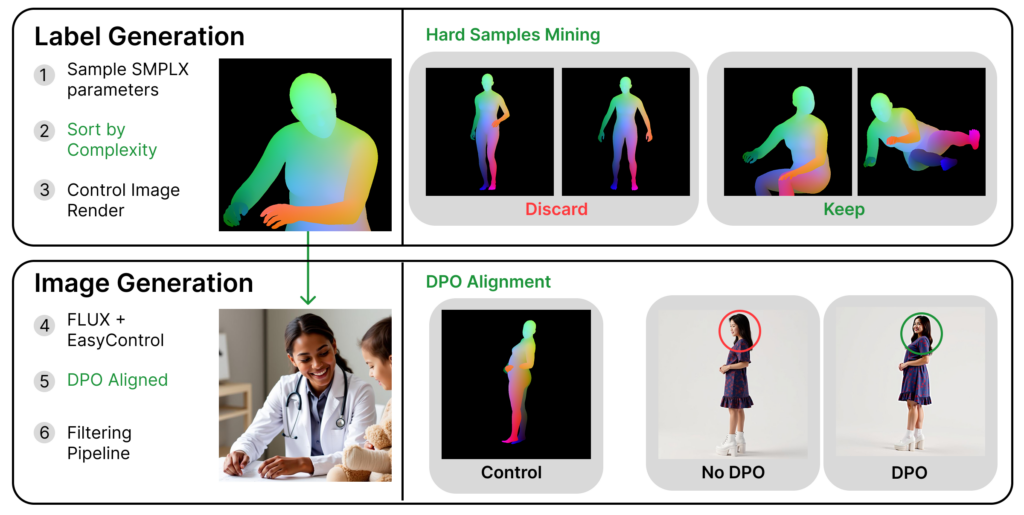
Data Generation. The pipeline begins with SMPL-X [46] parameter and caption generation from multiple sources, followed by curriculum-based hard sample mining to select challenging poses, and concludes with DPO-aligned controllable image generation and comprehensive quality filtering.
Looking beyond the laboratory
Accurate understanding of human movement is increasingly important in fields such as robotics, virtual and augmented reality, assistive technologies, and human-computer interaction. By reducing the reliance on expensive motion-capture facilities, PoseDreamer could make advanced movement research accessible to a wider range of researchers and organisations.
The team plans to make both the dataset and generation pipeline publicly available, enabling other researchers to build on the work and explore new applications. As generative AI continues to move beyond image creation and into scientific research, PoseDreamer offers a glimpse of how synthetic data may help overcome real-world limitations, opening new possibilities for understanding how humans move, perform, and recover.
[1] A 3D body mesh is a digital three-dimensional model of a person’s body shape and pose.