

We are proud to announce that Erik Vanegas Müller and Professor Mauricio Villarroel from the Podium Institute for Sports Medicine & Technology, together with colleagues from the Universities of Oxford and Birmingham, have published a systematic review in npj Digital Medicine this month, entitled: A Systematic Review of Explainable Artificial Intelligence and Cardiac Electrophysiological Models Addressing Sports-Related Sudden Cardiac Death and Arrest in Adolescents and Young Adults.
This systematic review examines how explainable artificial intelligence (xAI) and cardiovascular modelling can detect and prevent life-threatening heart problems in young athletes. Although these events are rare, SrSCD remains the leading medical cause of death among adolescent and young adult athletes. It often occurs without warning in individuals who otherwise appear healthy.
Sudden Cardiac Death (SCD) is a fatal event occurring within one hour of a witnessed or 24 hours of an unwitnessed cardiac arrest.
Sports-related sudden cardiac death (SrSCD) is an unexpected, non-traumatic death presumably of cardiac origin during or within one hour following exercise.
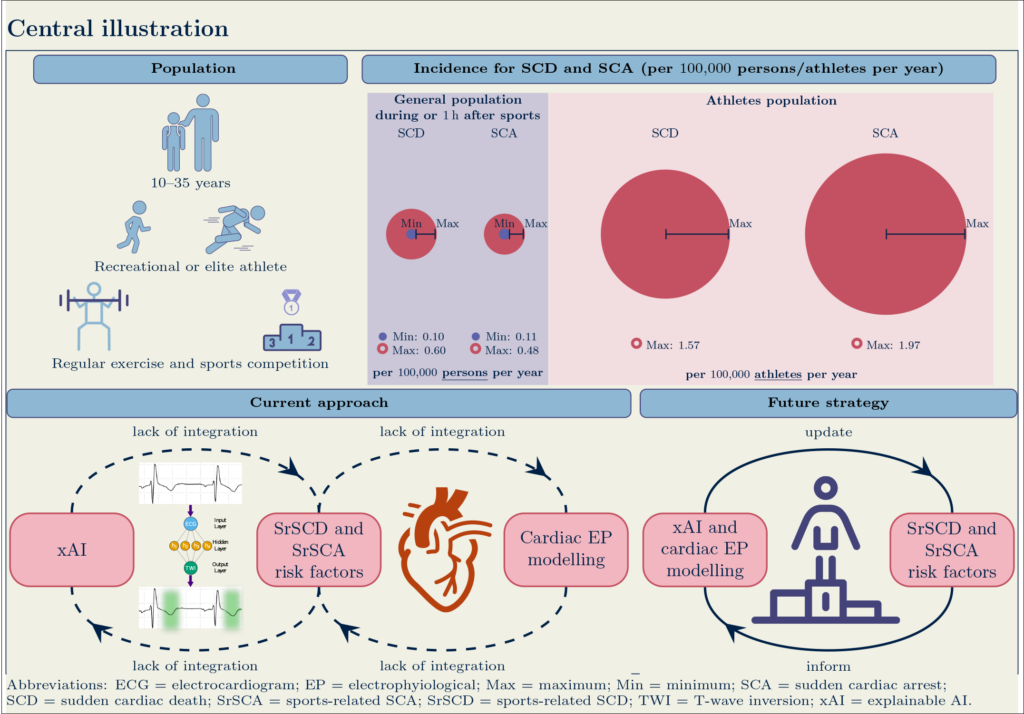
Drawing on 84 studies, the researchers examined how frequently these fatal events occur, how well xAI can identify life-threatening arrhythmias, and how cardiac electrophysiological modelling (computer simulations of the heart’s electrical or mechanical activity) may help explain their mechanisms. The SrSCD risk among adolescent and young adult athletes is up to 2 times higher, and the SrSCA risk up to 4 times higher, than in the general population. Approximately 74% of SCD cases occur during exercise and 4.2% within 1 hour after exercise. These findings suggest that sport can act as a trigger, with a post-exercise risk window. The authors found that xAI applied to life-threatening arrhythmias is an emerging field. Most studies used methods such as Grad-CAM to identify the areas of an image that influenced the AI’s decision, and the cardiac models used in these studies focused predominantly on electrophysiology at the cellular and tissue levels.
“I am happy to publish this important article after almost two years of taking the first steps. My co-authors’ input made this systematic review a true interdisciplinary approach. I believe that our work as engineers in the medical field reaches its full potential only when it is built around the needs and knowledge of the clinicians closest to the patient.” Erik Vanegas Müller, first author and Podium Institute DPhil candidate.
The review also highlights a key challenge: inconsistent SrSCD definitions, methods and reporting across studies make it difficult to compare findings directly or apply them consistently in screening and prevention. Data collection sources vary significantly; studies not only rely on nationwide registries but also on media monitoring, insurance claims, and voluntary self-reporting, which can compromise the accuracy of the reports. The authors call for standardised definitions of SrSCD and for the integration of known risk factors with xAI and computer models of the heart to improve the identification of athletes who may be at increased risk.
Professor Mauricio Villarroel, Associate Professor of Biomedical Engineering and one of the leading authors of the study, explained: “One of the challenges for young and adolescent athletes is distinguishing between pathological changes from normal athletic and growth-related adaptations. Erik’s work highlights the opportunities to develop modern AI methods to stratify the risk of life-threatening cardiac events in young athletes. AI and cardiac electrophysiological models can be powerful diagnostic tools for uncovering disease mechanisms and risk factors, enabling better prevention and personalised treatments.”
The Podium Institute for Sports Medicine and Technology, situated within the Institute of Biomedical Engineering at the University of Oxford and directed by Professor Constantin Coussios, is the world’s first independent academic institute focused on the safety and lifelong health of youth and grassroots as well as professional athletes. Its purpose is to forge evidence-based changes in sport and physical education, and to develop innovative and scalable technologies to monitor, analyse and ultimately prevent sport injury across the 22 million adults and 3 million children who participate in sport annually across the UK, as well as the hundreds of millions who partake in amateur and professional sport internationally.