

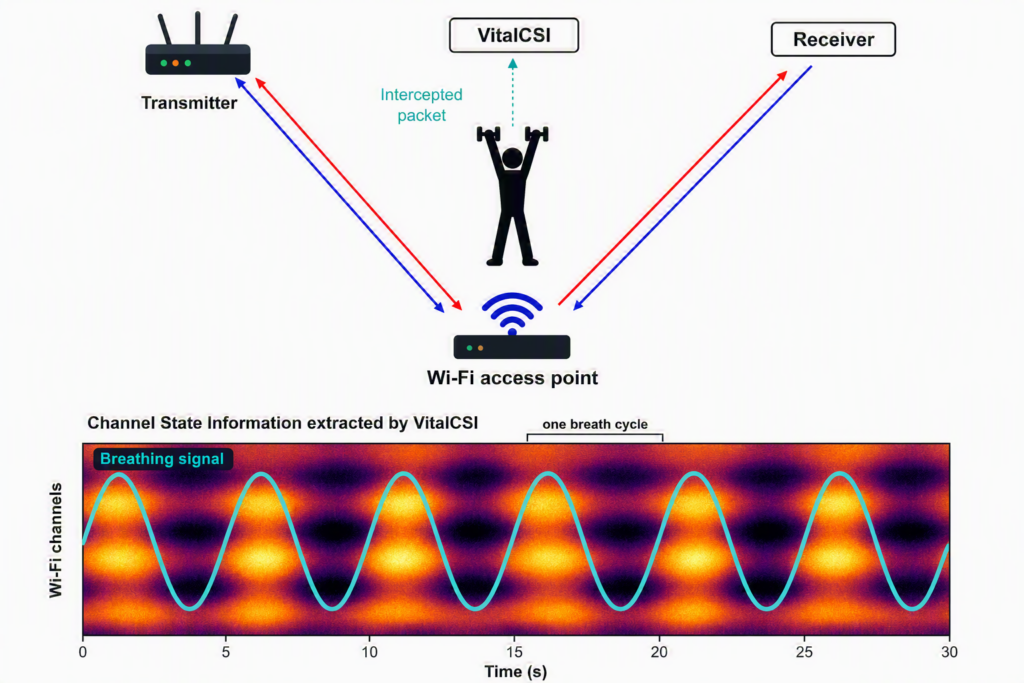
Researchers Nivedita Bijlani, Tom Michaelis, João Jorge, and Mauricio Villarroel from the Podium Institute and the Institute of Biomedical Engineering have developed VitalCSI, a prototype contactless respiratory rate monitoring system that uses consumer-grade Wi-Fi to measure breathing without the need for wearable devices, cameras, or direct physical contact with athletes. VitalCSI detects the subtle changes that breathing causes in everyday Wi-Fi signals and converts them into an accurate, continuous measure of respiratory rate. Because radio waves can travel through walls, the system can monitor breathing without requiring a direct line of sight. It also avoids recording images or audio, helping to preserve individual privacy.
The technology was validated in a group of young university athletes. It represents an early step towards unobtrusive physiological monitoring during sleep, rest, and training. The research behind VitalCSI has recently been published in Sensors: VitalCSI, a contactless respiratory rate monitoring system built on consumer-grade Wi-Fi
Respiratory rate – the number of breaths taken per minute – is one of the earliest warning signs of clinical deterioration. Channel State Information (CSI) is fine-grained data that Wi-Fi devices already compute to assess the strength of a signal travels between transmitter and receiver. Subtle, breathing-induced changes in this signal can be decoded to measure respiratory rate.
Making advanced monitoring more accessible
VitalCSI runs entirely on off-the-shelf hardware: a standard consumer Wi-Fi access point and a Raspberry Pi single-board computer, without the need of specialised radar or medical equipment. As a person breathes, the rise and fall of their chest changes the path the Wi-Fi signal travels, leaving a faint fingerprint in the data. VitalCSI measurements closely match reference clinical nasal airflow sensors across a wide breathing range between 6-33 breaths-per-minute. To our knowledge, it is the first validated system to provide continuous, contactless respiratory monitoring over a broad a range using everyday Wi-Fi hardware.
Dr Nivedita Bijlani, Podium Institute Postdoctoral Researcher said: “What excites me most is that none of this requires new hardware in someone’s home. The Wi-Fi router is already there. We are simply teaching it to notice the faint signature of a person breathing, and to do so reliably across the range of rates you would see in real life”.
From monitoring health at home to tracking recovery and well-being in athletes
The work also points to where it could matter most. Because the system needs no camera, wearable devices, or direct line of sight, it lends itself to settings where comfort and privacy are paramount – tracking nocturnal breathing through the night to flagging disturbances such as sleep apnoea or quietly monitoring an athlete’s recovery. For sports science, a contactless reading of respiratory dynamics opens a route to following individual training sessions and recovery without strapping equipment to the athlete. The cohort of young university athletes here provides an early, encouraging signal in the target population.
Prof. Mauricio Villarroel, Professor of Biomedical Engineering and senior author of the study, explained: “Respiratory rate is one of the most informative vital signs, yet it is one of the least monitored once a person leaves the clinic. Showing that an ordinary Wi-Fi access point and a low-cost computer can measure it accurately, through walls and without a camera or wearables, changes what continuous monitoring could look like in the home and in sports. It brings unobtrusive, privacy-preserving physiological monitoring within reach of equipment people already own”.
This study marks an important step towards a future where health and recovery can be monitored continuously and discretely, using everyday technology to provide meaningful insights while respecting comfort and privacy.